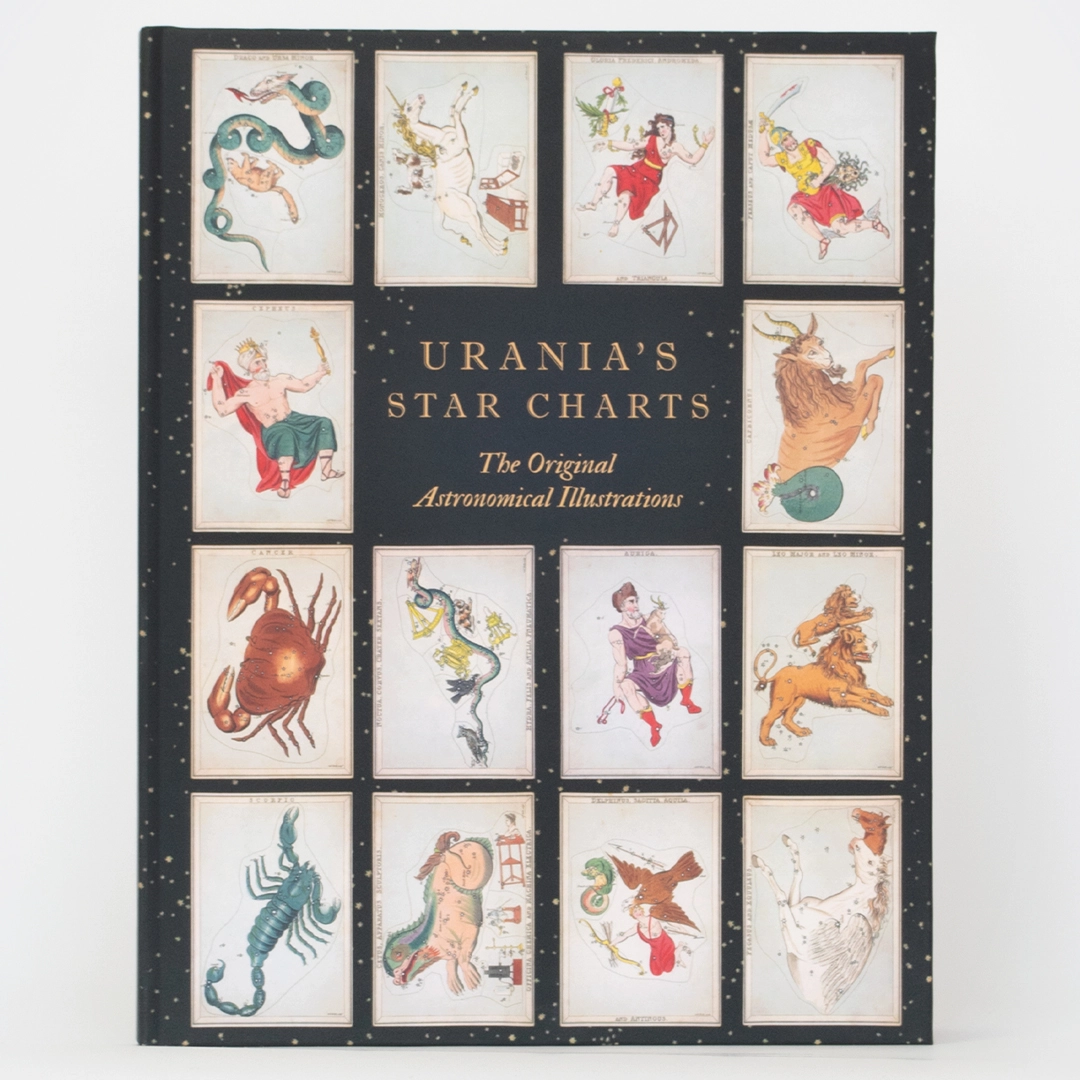
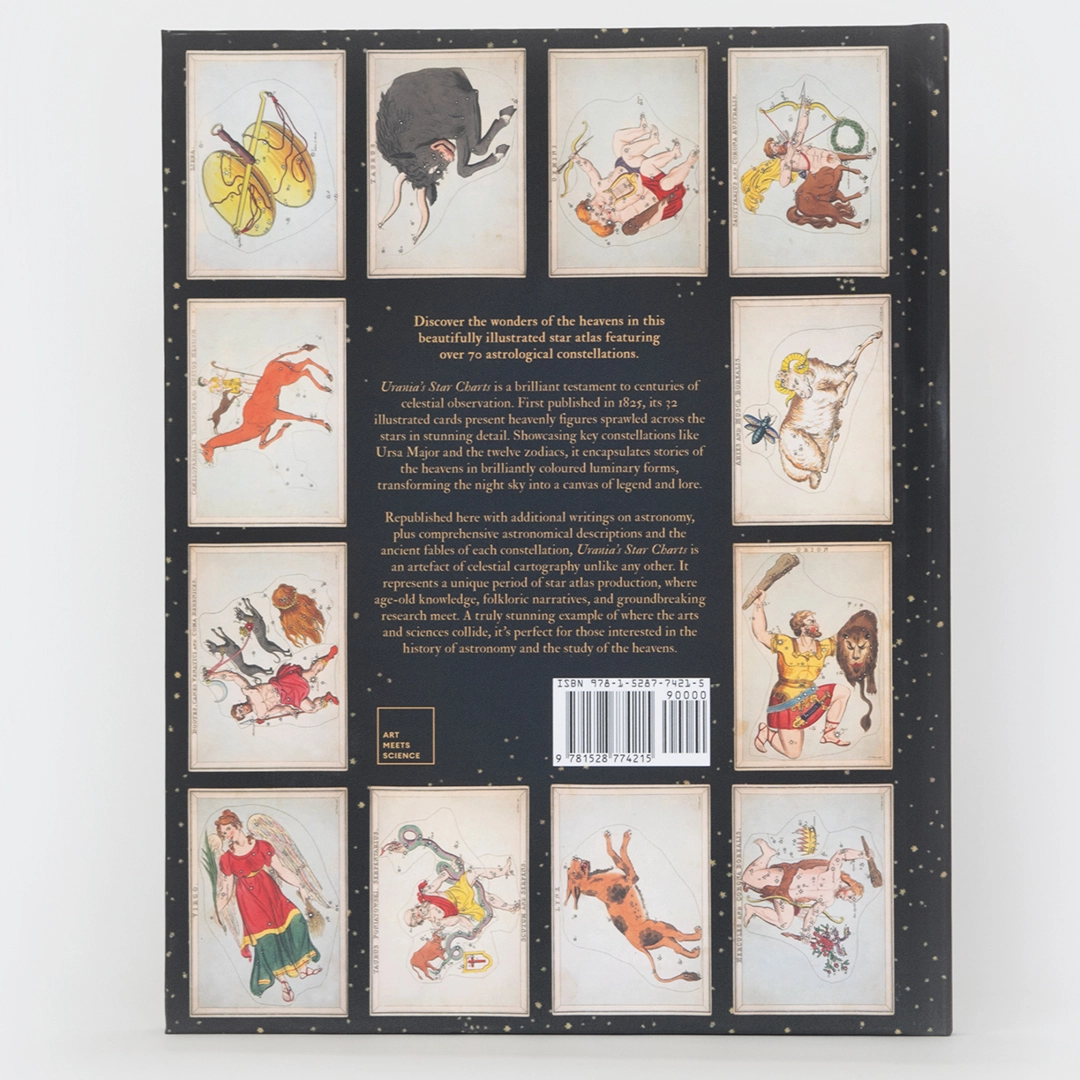
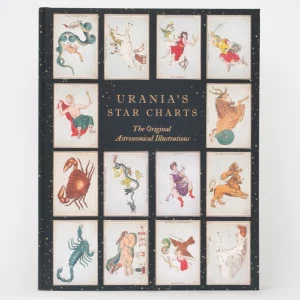

Thirty-two full-colour plates that turn the night sky into a gallery of gods, beasts, and heroes, Urania’s Star Charts is one of the most charming star atlases ever made.
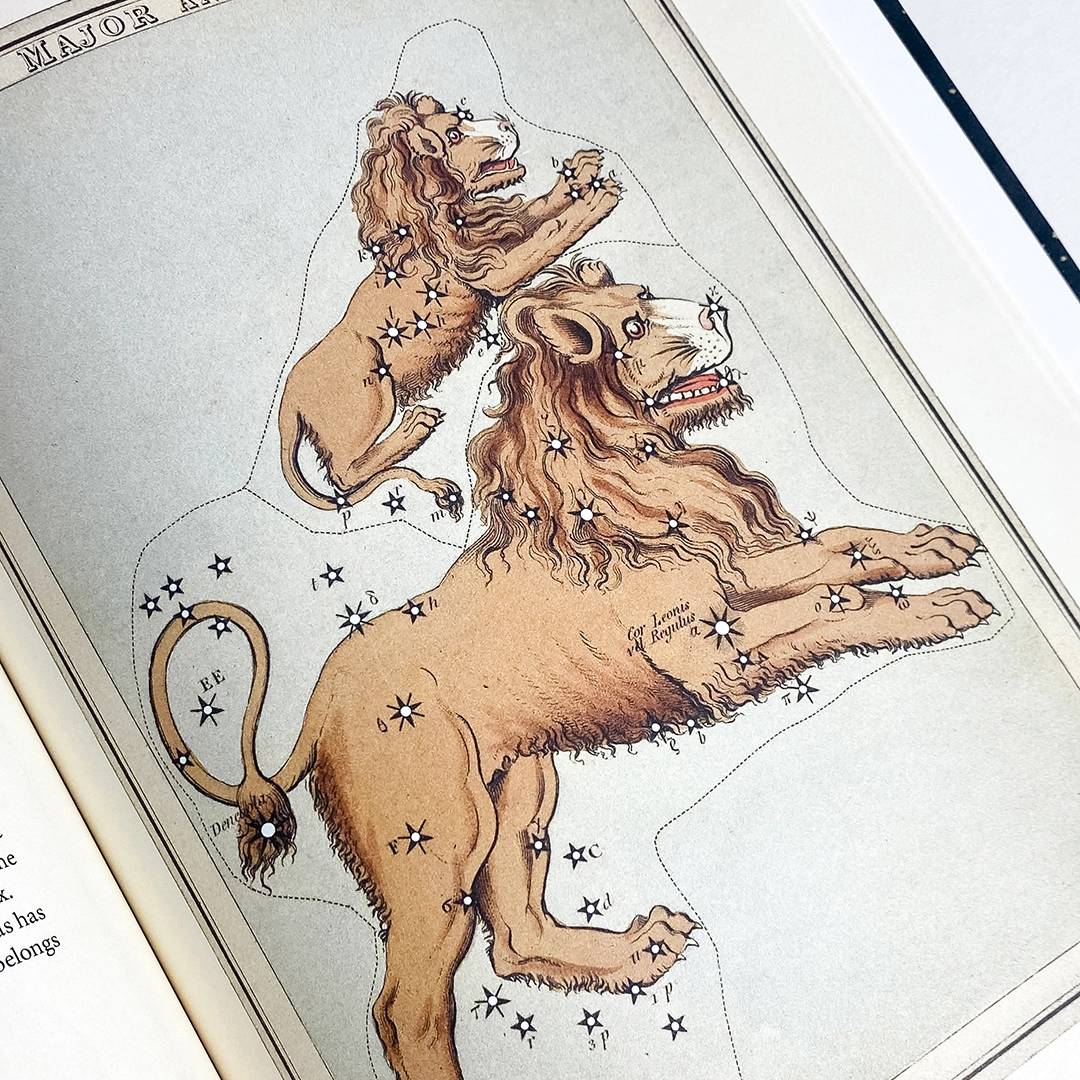
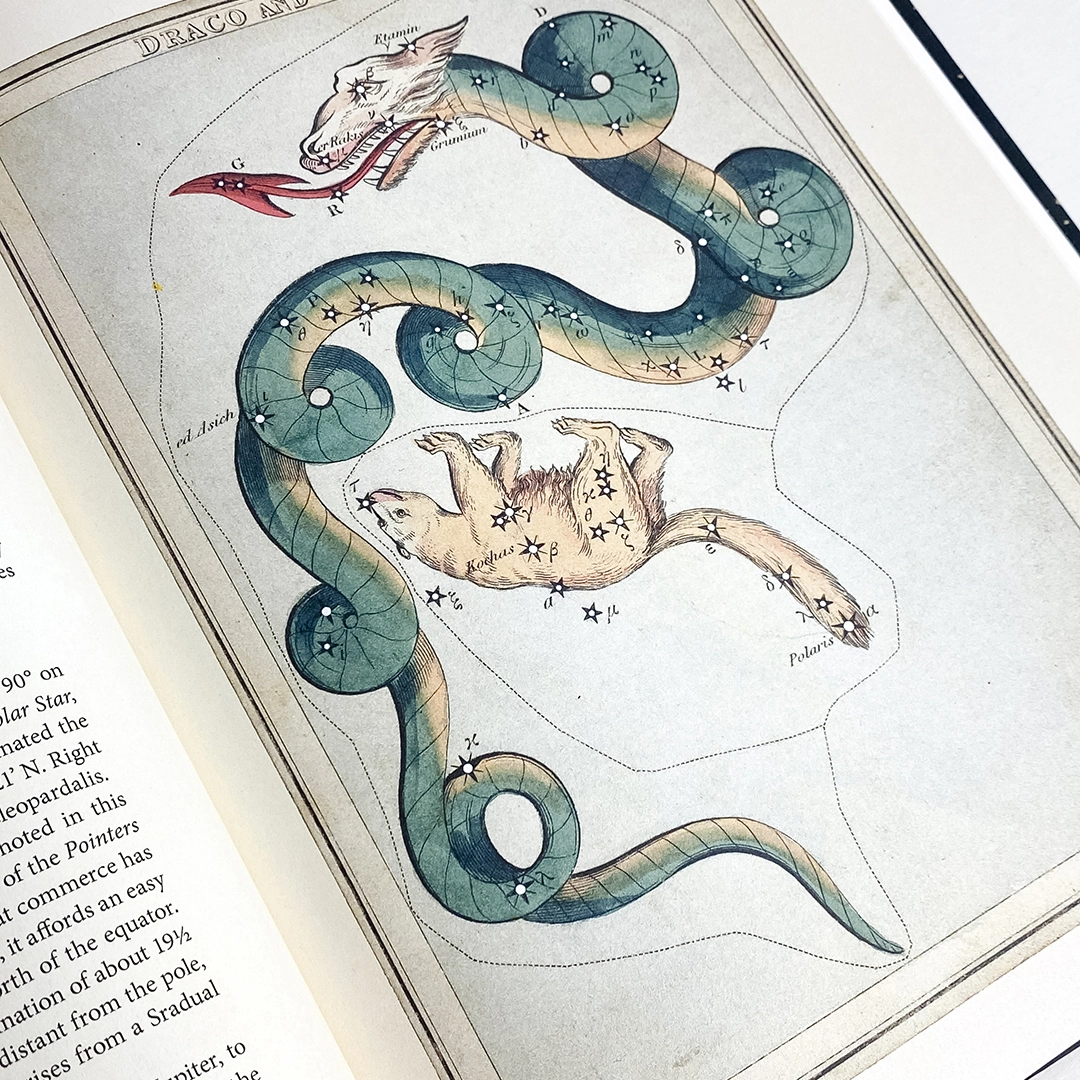
First published in 1824 as Urania’s Mirror, and reproduced here from the colour plates of the 1825 edition, it began as a boxed set of parlour cards. Each constellation is drawn as its mythological figure – a hunter, a great bear, a chained princess – with every star pierced with a hole sized to its brightness, so that, held up to a candle, each constellation glows against the dark just as it does overhead.
The stories of the figures themselves reach back thousands of years, to the Greeks and the Babylonians before them. Here they are as the ancients drew them and the nineteenth century loved to picture them: Orion with his club and shield, the swan and the serpent, the twelve figures of the zodiac wheeling through the year.
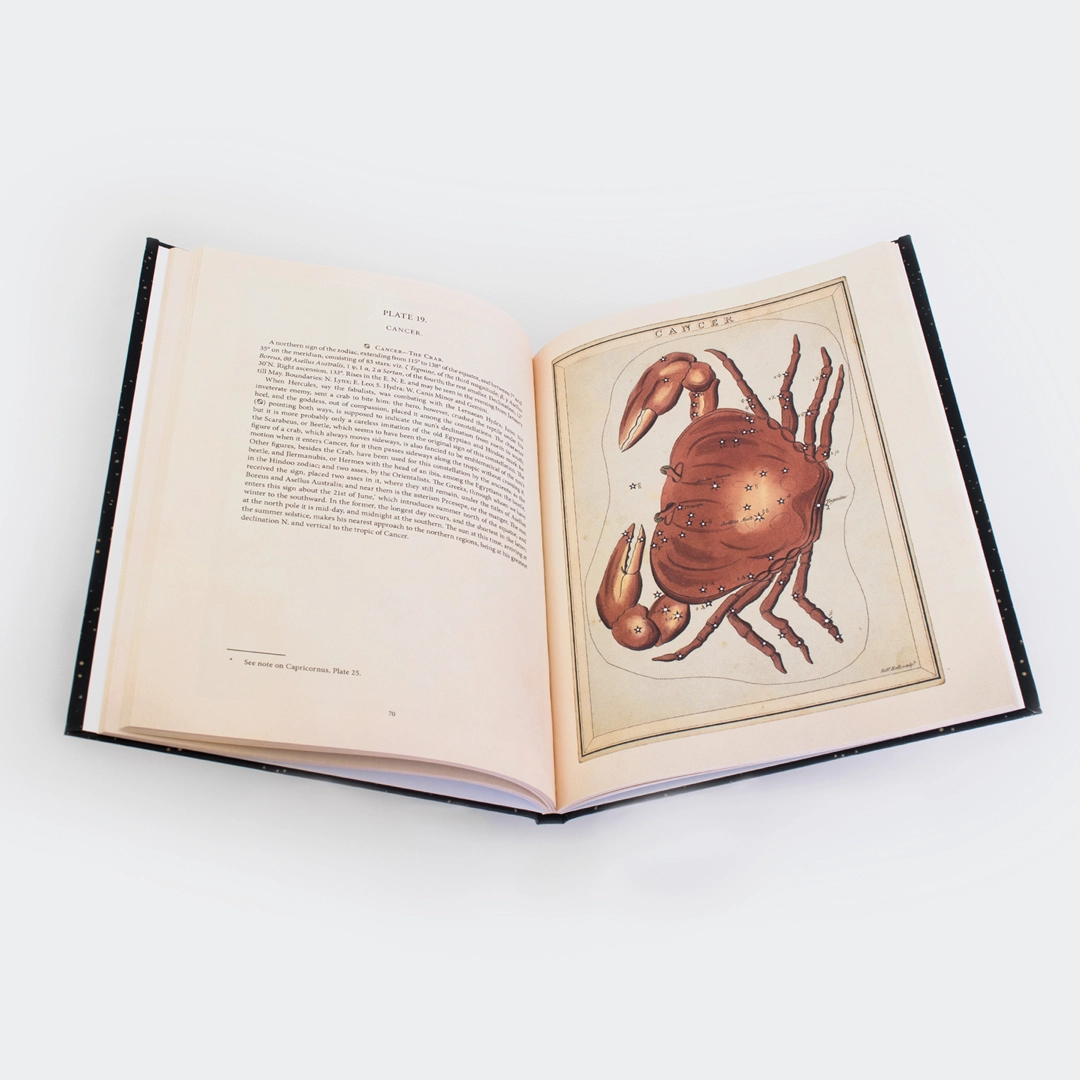
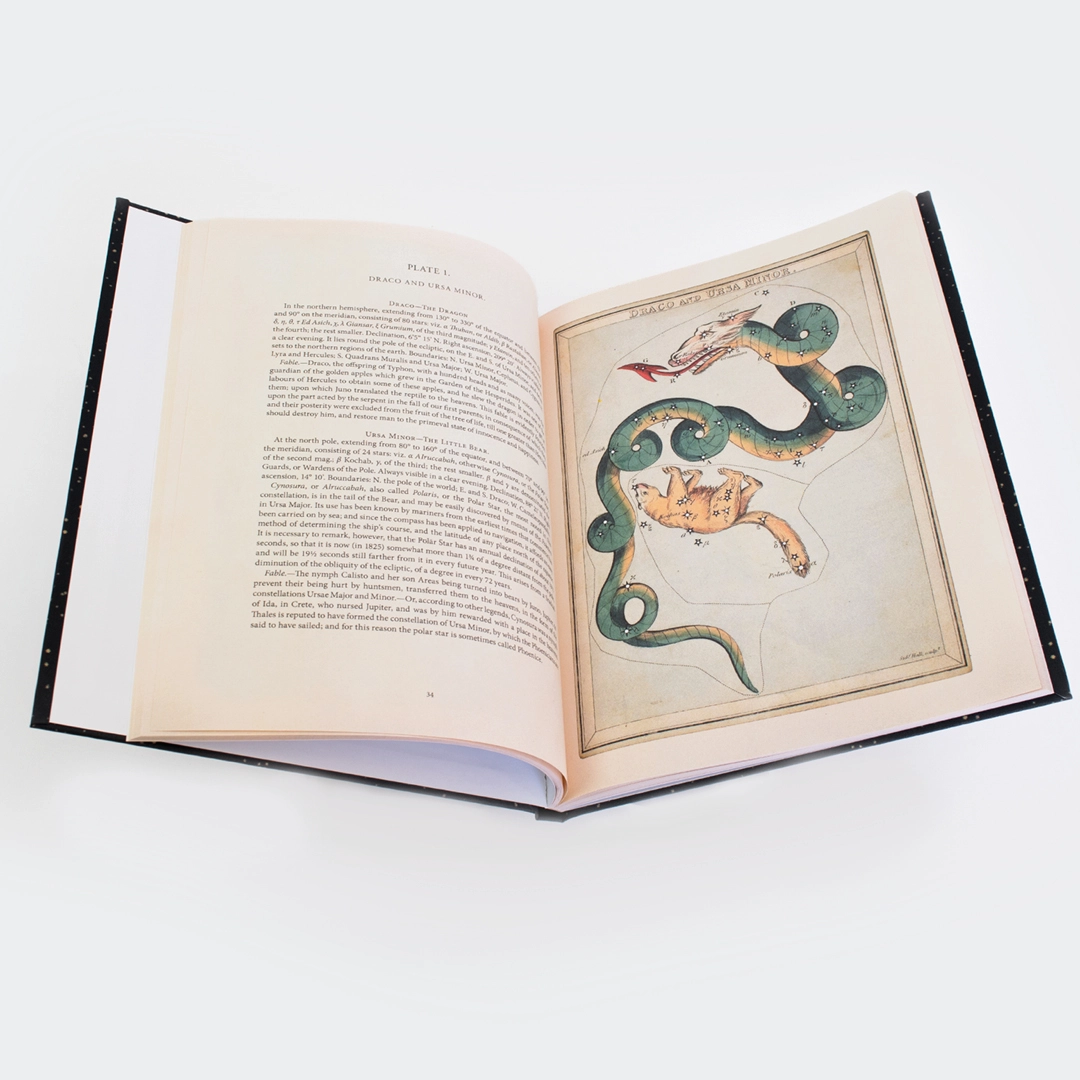
In this edition, each plate comes with text that tells its story, presenting the myth behind the name, the stars that compose it, and the lore handed down through millennia. More than a guide to the constellations, Urania’s Star Charts is a record of how people have read meaning into the heavens for as long as they have looked up.
For the stargazer, the collector, and anyone who finds joy in looking up at the night sky, Urania’s Star Charts gathers one of the most enchanting star atlases ever made, and one of the last to illustrate the sky in this way.
Urania’s cards bring the heavens down to earth, visualising a branch of science that everyone can see but not always understand. As we researched the illustrations further, a whole line of history unravelled. Its illustrations beautifully express what came before: centuries of astrological understanding, developments in celestial cartography, illustration styles, and social culture repackaged as curious parlour objects to entertain first and educate second.
“After discovering these illustrations in an online archive, I visited the library to see them in person. Expecting a book, I was happily surprised to have a box of cards delivered to the desk. Each one was beautifully coloured, punched full of holes, and covered in silver paper on the reverse. When held up to light, it’s as if you’re holding the constellations in your hands.— Emily, Editor
Contents:
“Among the many ingenious and beautiful inventions to promote the study of science, and render it as delightful as it is valuable, we have never seen any thing to surpass this admirable production.”—Literary Gazette, 1825
“An ingenious and useful work.”—Examiner, 1825
“One of the most elegant and acceptable guides to astronomy.”—News, 1825
“A most pleasing and beautifully adorned display of the constellations.”—Morning Chronicle, 1825
“The plan upon which instruction in that most sublime of all sciences, astronomy… is not merely original, but is entitled to the highest praise for its elegance and ingenuity.”—British Press, 1825
As the first humans explored the world, they sought to understand the skies above. While they mapped the constellations for practical purposes like navigation and farming, their understanding of the heavens was closely linked to the divine, with the stories of gods and goddesses informing their observations. The art of celestial cartography, or uranography, produced beautiful star maps that recorded planets and stars from different points on the globe. These early maps were heavily based on astrological understanding, with folkloric beliefs at their centre, and were greatly influenced by each country’s culture. Founded on mediaeval manuscripts and mythological texts, key astronomers like Ptolemy (c.100–c.170 AD) and Al-Ṣūfī (903–986 AD) penned stellar nomenclatures that encapsulated popular literary stories with the coordinates of the stars and planets they observed. Such classical works were incredibly influential in the study of astronomy before the fifteenth century, resulting in early star atlases that presented constellations formed around mythological narratives, brilliantly illuminated with figures and animals. They were continuously reimagined but often used outdated coordinates, and so misinterpreted the constellations as they existed in the skies above. Despite their beauty, many star maps became objects of fancy rather than being used for precise celestial understanding or navigation.
—From the Introduction
Where earlier star atlases were built for measurement, Urania’s Mirror reimagined the form for a popular audience. Presented on individual cards, it depicted the heavens without the coordinate grids and technical apparatus of scientific atlases like those of Bayer and Flamsteed – the designs adapted instead from Alexander Jamieson’s more decorative celestial atlas of a few years earlier. Each card was perforated where the stars lay, the size of every hole matching the brightness of its star, so that held up to the light, the constellation seemed to come to life. Because they were made to be handled this way, few complete sets survive – many being damaged when held too close to the candle flame.
For much of its life the set carried a small mystery. Its designer was named only as “a young lady”, and the anonymity drew speculation for over a century – the astronomers Mary Somerville (1780–1872) and Caroline Herschel (1750–1848) were both proposed, as was the cards’ engraver, Sidney Hall (1788–1831). Only later was the maker identified as the Reverend Richard Rouse Bloxam (1765–1840), an English schoolmaster. Perhaps the initial anonymity was a way to make the work appeal across the sexes, as was the style for publications during the period, or maybe it was a way to avoid accusations of plagiarism due to the illustrative similarities to Jamieson’s atlas.