Few figures in the history of science have captured the relationship between observation, perseverance, and imagination as vividly as palaeontologist Mary Anning.
Anning’s fossil discoveries along England’s Jurassic Coast not only revealed the remains of previously unknown species, but also helped reshape nineteenth-century understanding of the history of life on Earth. Working outside formal scientific institutions, her work stands as both a landmark in the history of palaeontology and a powerful example of resilience in the face of social and institutional barriers.
Mary Anning and Her Early Life on the Jurassic Coast
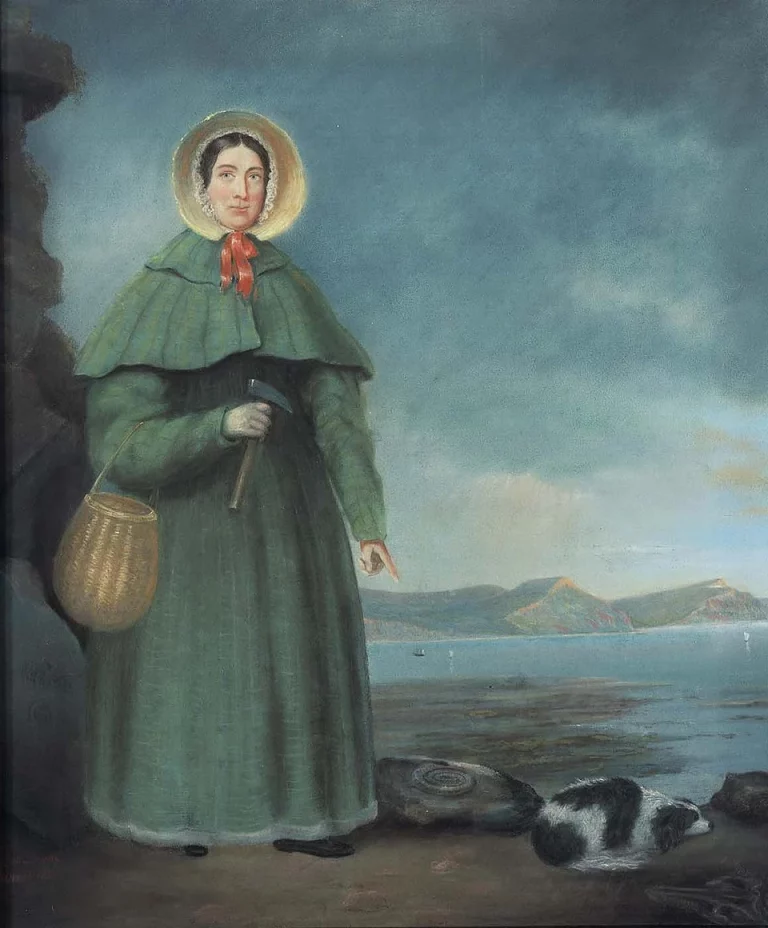
Born in May 1799 in the seaside town of Lyme Regis, Mary Anning (1799–1847) grew up in a landscape that would prove central to her life’s work. The surrounding cliffs, now part of the Jurassic Coast, are renowned for their rich deposits of fossils dating back over 180 million years.
Anning’s introduction to fossil collecting came through her father, Richard, a cabinetmaker who supplemented the family income by selling curiosities to tourists. Together, they searched the beaches and cliff faces, learning to identify and extract fossilised remains from the rock. After his death in 1810, fossil hunting became her primary means of income, despite her young age.
Fossil hunting and discoveries
Working under frequently hazardous conditions, Anning learnt to locate and recover fossils revealed by landslides and winter storms. Such work required careful timing: while storms exposed new specimens, the advancing tide could swiftly obscure or destroy them. Her success relied on a combination of physical resilience, close observation, and an increasingly sophisticated understanding of geological formations.
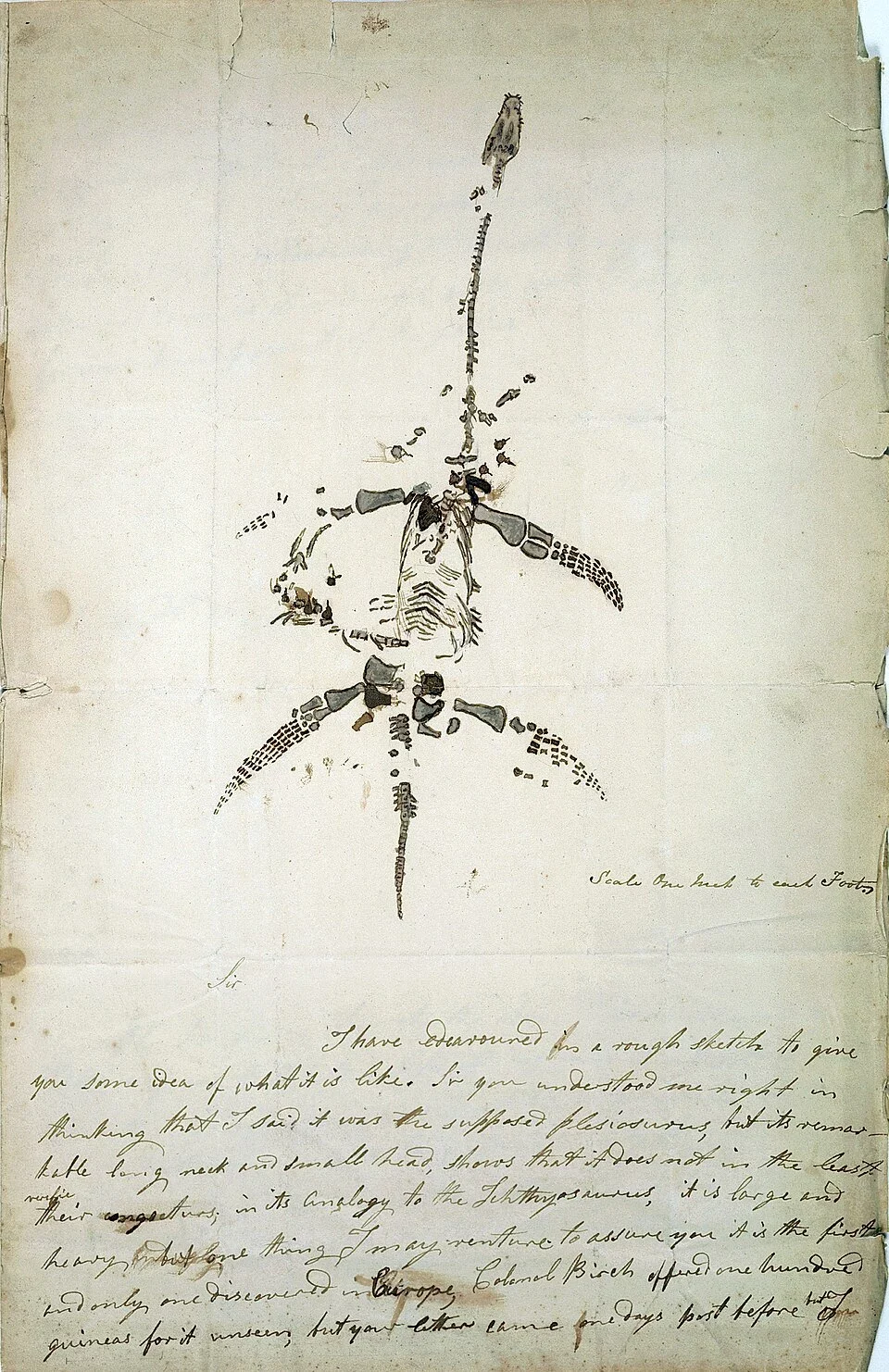
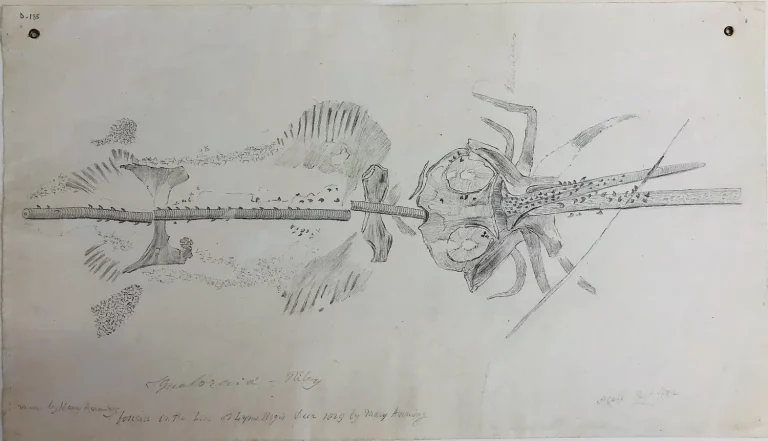
Among her most significant discoveries was the first correctly identified skeleton of an Ichthyosaur, as well as two notably complete skeletons of Plesiosauri, two species clearly adapted to life in the ocean. In addition, her discovery of a Pterosaur – the first specimen of its kind identified outside Germany – extended contemporary knowledge of prehistoric life beyond marine environments.
"The greatest fossilist the world ever knew."
Charles Dickens, All the Year Round, 1865
Her discoveries provided critical evidence in the emerging debates surrounding extinction and the age of the Earth, at a time when many naturalists still understood the natural world as fixed and unchanging. The fossil remains uncovered by Anning offered compelling, tangible proof that entire species had once existed and subsequently disappeared, challenging prevailing assumptions about the permanence of life. In doing so, her discoveries contributed to a broader shift in scientific thought, supporting the view of the Earth as dynamic and historically layered rather than static.
Mary Anning: Woman of Science
Despite her expertise, Mary Anning remained on the margins of the scientific community in early-nineteenth-century Britain. Institutions such as the Geological Society of London did not yet admit women, excluding her from formal participation in the legitimate networks and publications. As a result, many of her discoveries were described in papers authored by male contemporaries.
Despite these limitations, her reputation among leading scientists was considerable. She corresponded with and supplied specimens to prominent figures, including Henry De la Beche (1796–1855), a close friend and fellow palaeotologist; theologian and geologist William Buckland (1784–1856), who played a key role in advancing geological studies at the University of Oxford; and Gideon Mantell (1790–1852), whose work on fossil reptiles started the scientific study of dinosaurs in the nineteenth century. She was also in contact with Richard Owen (1804–1892), first superintendent of the Natural History Museum and a celebrated naturalist who first named ‘dinosaurs’, whose later contributions to the study of extinct animals drew upon Anning’s specimens.
Art, Science, and "Duria Antiquior"
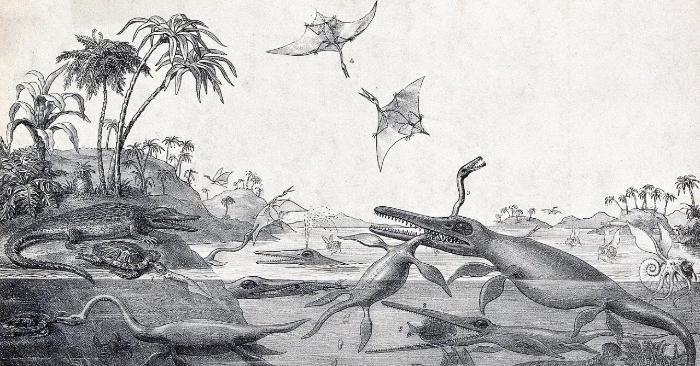
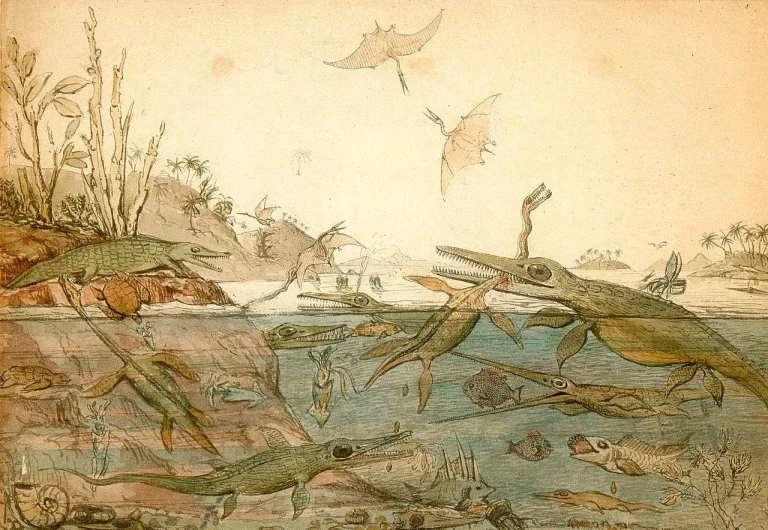
Anning’s influence extended beyond scientific circles into the visual culture of the time. Drawing on personal illustrations of specimens, her friend, Henry De la Beche, created the famous illustration Duria Antiquior (meaning “A More Ancient Dorset”) in 1830. Based on fossils Anning had discovered, it is widely regarded as the first visual reconstruction of a prehistoric ecosystem.
Rather than presenting isolated specimens, De la Beche situates multiple species within a single, animated scene. Ichthyosaurs are shown in motion, their bodies curved as they pursue prey, while plesiosaurs extend their long necks through the water in search of food. The creatures interact – hunting, feeding, and consuming one another. This emphasis on behaviour marks a significant departure from earlier scientific illustration, which tended to depict specimens as static, isolated, and decontextualised.
As a piece of early palaeoart, it translated scientific discovery into a form accessible to a broader public. Lithograph prints of Duria Antiquior by George Scharf (1820–1895) were sold to help support Anning’s work, reflecting both her financial precarity as an unfunded palaeontologist and the growing recognition of her importance within the scientific circles.
Mary Anning's Legacy
Mary Anning’s contributions played a foundational role in the development of modern palaeontology. By revealing distinct forms of ancient marine life preserved within specific geological strata, her work helped to establish a clearer relationship between fossils and deep geological time. The specimens she uncovered enabled early attempts to reconstruct ancient ecosystems, offering insight into forms of life that predated human history by millions of years.
Three years after her death in 1847, Anning was formally recognised for her contributions to science by the Geological Society, which commissioned a stained glass window in her local church in her honour.
Anning is now recognised not only for the importance of her fossil discoveries, but also for the intellectual rigour and persistence that characterised her work. She contributed to the formation of a new scientific discipline, leaving a legacy that continues to inform both scientific inquiry and artistic interpretations of the prehistoric world.
Get More from Art Meets Science
-
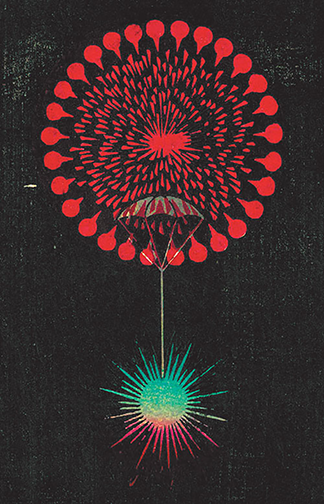
Art/Chemistry/Illustration/Japanese Woodblock/Pyrotechnics/ScienceSelect options This product has multiple variants. The options may be chosen on the product pageJinta Hirayama’s Japanese Firework Illustrations
£6.99 – £24.99Price range: £6.99 through £24.99 -
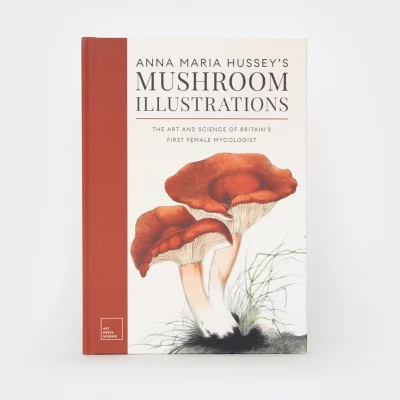
Nature/Botany/Illustration/Mushrooms/MycologySelect options This product has multiple variants. The options may be chosen on the product pageAnna Maria Hussey’s Mushroom Illustrations
£7.99 – £29.99Price range: £7.99 through £29.99 -
Art/Color TheorySelect options This product has multiple variants. The options may be chosen on the product pageMunsell’s Colour System
£7.99 – £25.99Price range: £7.99 through £25.99 -
Art/Astronomy/ScienceSelect options This product has multiple variants. The options may be chosen on the product pageUrania’s Star Charts
£7.99 – £29.99Price range: £7.99 through £29.99 -
Art/Color TheorySelect options This product has multiple variants. The options may be chosen on the product pageEmily Vanderpoel’s Color Problems
£7.99 – £34.99Price range: £7.99 through £34.99 -
Animals/Butterflies & Moths/NatureSelect options This product has multiple variants. The options may be chosen on the product pageMaria Sibylla Merian’s Metamorphosis
£9.99 – £34.99Price range: £9.99 through £34.99